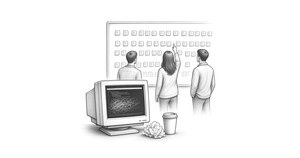
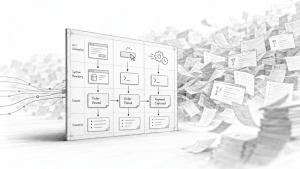
The whiteboard is full of boxes. Customer, Policy, Claim, Payment, each with its properties and the lines that connect them. The engineer who drew it is proud of it, and with good reason. It is clean, it is normalised, and it has served him well for years.
Early December, a ticket lands in the support queue, marked urgent. A customer writes that she cancelled her life policy during the cooling-off period, at 23:58 on 30 November, two minutes before the deadline. Her policy is still active, and her premium has been collected again.
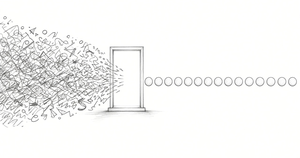
Nobody decided to build a distributed monolith. It happened one shortcut at a time. Every outside system speaks its own language, and it changes that language without asking you. If its words flow straight into your code, every change on their side becomes a change on yours.
Picture an insurer where a batch of policy owners is charged twice for the same monthly premium. No alarm goes off. No job fails. The logs look clean. The first sign of trouble is a stack of complaints, weeks later, and then a long afternoon of reconstructing which charges went out when, and why.
Picture a bank that must send customers certain notices and statements. A background job is supposed to generate and send them. One day it quietly stops for some of them, and nobody notices. When someone finally does, thousands of letters have to be recreated and sent in batches, and the regulator is involved. It isn't a coding chore anymore. It's a compliance problem.
Many people new to vertical slice architecture and CQRS make the same mistake: they only think of shared read models, or of one canonical read model that every screen reads from. But to keep things really loosely coupled, or not coupled at all, every single use case gets its own read model.
When I analyse the code of a legacy application, or of an application built with hexagonal architecture, I have a hard time finding the logic that belongs to a business feature such as cancelling a policy. I have to open 14 files and I'm completely lost. A non-technical person has no chance of understanding the code.
I recently talked with one of our lead engineers, and the conversation stayed with me. He finds the new reality hard to accept, and he isn't the only one. AI and agentic coding are changing how we work.
Dynamic Consistency Boundaries give us another way to think about correctness in event-sourced systems. Consistency belongs to decisions, not to aggregates.
Before optimizing another handover, ask why it exists. Joint exploration of one business activity, with an Event Model as the shared blueprint everyone can challenge.
Modelling business processes, that's precisely where EventModeling shines. It provides the bridge between business understanding and system design, helping us developers stay grounded in actual business processes instead of drifting into premature abstractions.
As developers, by habit or training, we tend to look for patterns and generalize — to avoid duplication and to "future-proof" the system. At first glance, that sounds architecturally elegant — but in business terms, it's often misguided.