Part 1 of 2
The whiteboard is full of boxes. Customer, Policy, Claim, Payment, each with its properties and the lines that connect them. The engineer who drew it is proud of it, and with good reason. It is clean, it is normalised, and it has served him well for years.
"This is how the business works," he says.
I ask him a simple question. When did a claims handler last tell him about the properties of a Claim entity?
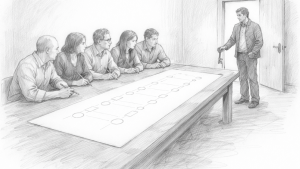
Never. A claims handler talks about what she does. A claim comes in. She checks the cover. She asks for a medical report. She approves, or she declines and explains why. She thinks in activities and in the order they happen, not in entities and their attributes.
I have yet to meet a business expert who thinks in ERDs. If we engineers keep modelling the world as entities and aggregates, we will always speak a different language than the people we build for. And we will keep translating, and keep losing things in the translation.
(These scenes are composites, drawn from many teams over many years, not real people.)
The story everyone reads differently
A second room. A product owner has spent weeks on the backlog. The epics are well structured, the user stories follow the template, and the acceptance criteria are written with care. Nobody doubts the intent.
I suggest that even the best story is ambiguous. Not because it is badly written, but because it is text. Text always has to be interpreted. Hand the same story to a developer, a tester, a compliance officer and an operations analyst, and you get four mental models. Each of them is reasonable. They are not the same.
The answer I usually get is not "let's test that". It is some version of "our stories are good enough".
In an Event Model there is far less room for interpretation. Every screen, every command, every event and every view is on the board, in the order things happen on a time axis. Everyone looks at the same picture. Each step has concrete examples, so disagreements show up on the board, not in production. It is explicit, and it is simple to grok.
The wall
These two rooms are not exceptions. I have a head full of ideas and the energy to improve processes, products and services that don't work as well as they could. And too often, when I share them, I run into a wall.
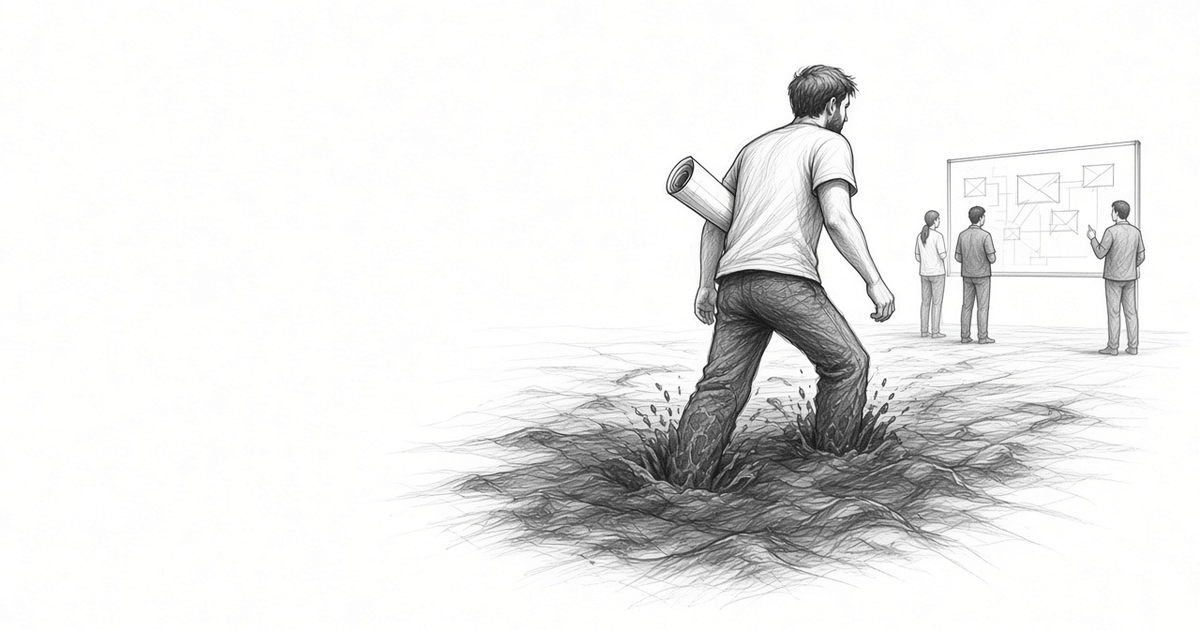
New ideas can feel like a threat. Question an orthodoxy or a legacy process, and the conversation changes temperature. People get defensive. They double down on what they know: agile, SAFe, the next framework on top of the last one. Even when I can show it on a whiteboard. Even when I can show it in a running application.
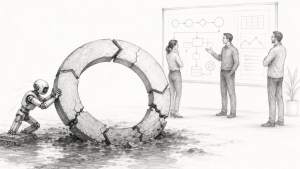
It feels like wading through mud instead of running through thin air.
I have worked in places where new ideas get tried within the week. I know that pace is possible.
Staring the cobra in the eyes
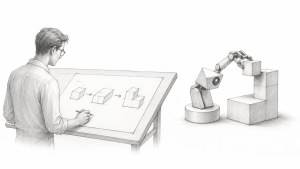
Look at what is around us. AI that writes code and reasons about it. The tools for doing things radically differently have never been better.
And yet many of us seem frozen. We are staring the cobra in the eyes, paralysed. Instead of trying radically new methods, we micro-optimise the software development lifecycle and the enterprise processes around it. One more ceremony. One more template. One more tool bolted onto a process that is fundamentally broken.
It isn't stupidity
I want to be fair here, because this is not about smart people versus slow people.
The engineer with the ERD and the product owner with the backlog are good at their jobs. Those tools made them successful. They shipped real products with them. Letting go of a tool like that feels like letting go of part of your track record.
That is attachment, not stupidity. And attachment is human.
But the cost of staying put is rising. AI amplifies whatever process you drop it into. Put it into a clear process and you go faster. Put it into an ambiguous one and you produce ambiguity faster. I wrote about this in AI Will Not Fix a Broken SDLC and in The blueprint before the agent, so I won't repeat the argument here.
The short version: the mud gets thicker the longer we stand in it.
What comes next
Complaining about the wall doesn't move it. So in part 2 I'll get practical.
If AI agents are going to be part of how we build software, we should work with them the way we work with a well-run team. That means clear roles, delegation with measurable goals, and trust that is earned from measured outcomes instead of being granted on faith. And it means a shared blueprint that humans and agents both read the same way. For me, that blueprint is the Event Model.
Originally published on LinkedIn on 16 Nov 2026: https://www.linkedin.com/pulse/wading-mud-why-good-ideas-hit-wall-gabriel-n-schenker-dsmcf/