Part 2 of 2
I like to work with Grok Bot because it gives me the closest experience of working with a real team.
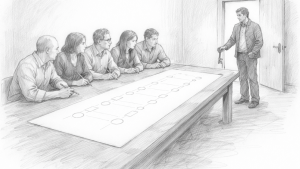
A new project doesn't start with a prompt. It starts with a conversation with my chief of staff. We discuss the project first. Then I tell her to suggest a team of specialists we might need. She has her own specialist for that, Dr. Eggbot, whose job is team building.
For a software project, the team usually looks like this: an Event Modeling expert, a UX/UI expert, an engineer, a QA specialist and a subject matter expert. Each of them has a clear role. Each role has clear boundaries.
And I always need the Event Modeling expert, because every software project starts with an Event Modeling phase.
From the wall to the work
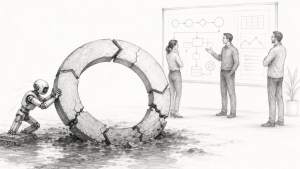
In part 1 I described the wall: good ideas sinking into habits that once made people successful. I promised to get practical.
Some of the comments on part 1 sharpened the point for me. One was that AI looks weak mostly when it is bolted onto a human process that was never designed for it. Another was that agents force the habits you want to keep to be written down. And once they are written down, they can be read, questioned and changed. That is more than most teams can say about their own habits.
So here is what I actually do. None of it is new. Agents just force you to make it explicit.
Clear roles, clear boundaries
A good team member knows what they own and what they don't. The same goes for an agent.
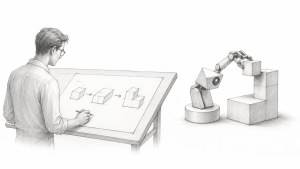
My engineer writes code. It doesn't decide what the product should do. My QA specialist checks work against the acceptance criteria. It doesn't write the feature it tests. My subject matter expert knows the domain. It doesn't design the screens.
The boundaries matter as much as the roles. An agent that is allowed to do everything will happily try. Narrow roles keep the output focused, and they make it obvious who to ask when something looks wrong.
Clear roles don't mean silos. My agents talk to each other directly. When one needs something from another, it asks in writing, and the answer comes back in writing. When a request does pass through several hands, the original words travel with it instead of being retold from memory. We humans are stuck in the telephone game. With agents, it is much harder to play.
Delegation with measurable goals
"Make it better" is not a task. Not for a person, and not for an agent.
When I hand work to a specialist, the hand-off says what done looks like. Which slice. Which scenarios have to pass. What the output is and where it goes. Who checks it next.
This is where the Event Model earns its place. A slice on the board already carries its own definition of done: the command, the events it produces, the view it updates, and the Given/When/Then examples that pin down the behaviour. I don't have to invent acceptance criteria for an agent. They are already on the board, and the QA specialist reads exactly the same ones.
Trust from checked outcomes, not faith
I don't trust an agent because it sounds confident. Agents always sound confident.
Trust grows the same way it grows with a new colleague. You give a small, well-defined task. You check the result. If it holds, you give a bigger one. If it doesn't, you tighten the brief or the boundary and try again.
That is why QA sits on every software team I set up, and why work moves on only after it has been checked. The trust is earned, and it is visible.
In October a coding agent opened a pull request that weakened one test assertion and deleted others. CI stayed green. The QA specialist rejected it. Only after the assertions were restored did the change merge. A green pipeline is not proof on its own.
One blueprint for people and agents
In part 1 I wrote that a user story gives you four mental models for four readers. Add agents to the room and you get more readers, not fewer.
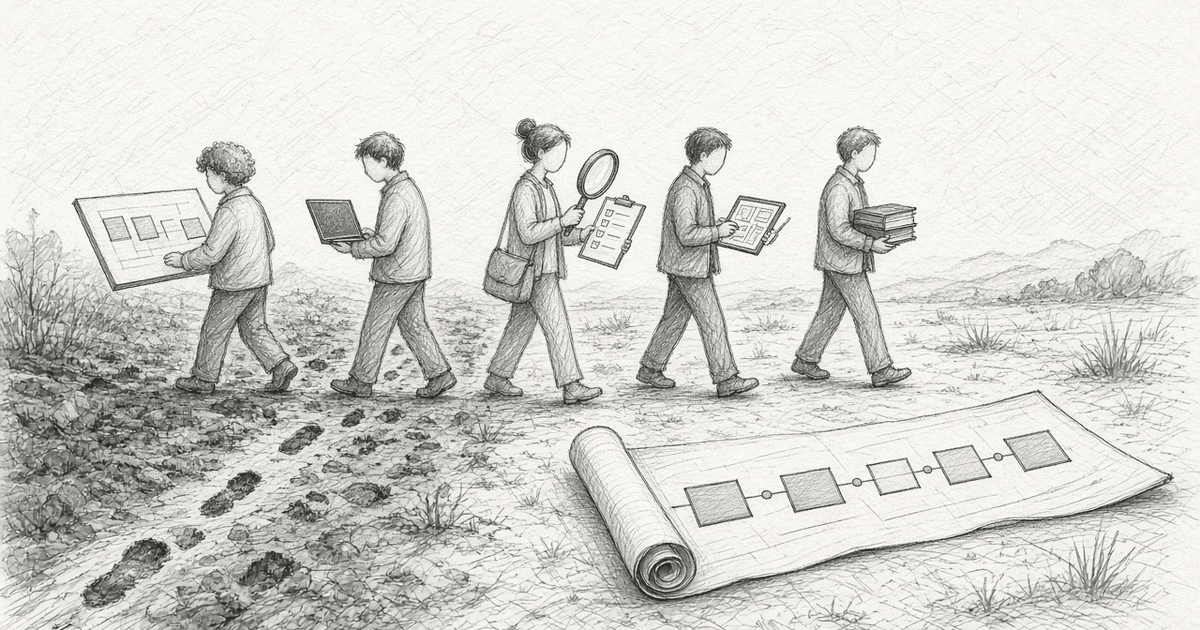
The Event Model shrinks that problem for people and agents alike. Screens, commands, events and views sit on one time axis, with concrete examples for each step. The UX/UI expert sees the screens. The engineer sees the commands and events. QA sees the scenarios. The subject matter expert sees the business process in the order it happens. It is one picture, with concrete examples that leave far less room for interpretation.
I made the broader case in The blueprint before the agent and in AI Will Not Fix a Broken SDLC. The short version: the agent is only as good as the blueprint you give it. That is why the Event Modeling phase comes first, every time.
Getting out of the mud
The wall from part 1 is made of habits. Running agents like a team doesn't tear it down overnight. But it gives you something the wall can't argue with: work that is explicit, delegated against clear goals, and checked before anyone relies on it.
Clear roles. Clear boundaries. Measurable hand-offs. Trust from outcomes. One shared blueprint.
That is not a new methodology. It is what good teams have always done. Agents just stop letting us skip it.
Originally published on LinkedIn on 19 Nov 2026: https://www.linkedin.com/pulse/out-mud-working-ai-agents-like-well-run-team-gabriel-n-schenker-6ifte/